THE REEFER MADNESS ERA
 NewsPaper Index
|
The Editorial Pages
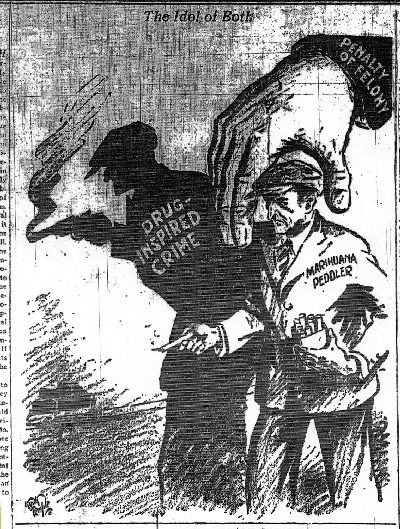
"The Idol of Both"
June 5, 1930 pg5 - New Orleans Times-Picayune
Just what effect did the newspaper editorial pages have on the creation of the original anti-Medical marihuana laws? Probably quite a lot. A quick glance through the museum's newspaper index (Admittedly only a small fraction of the total) shows just how many "Editorial" articles there were.
The sad and almost unexplainable fact is that just about ALL of these editorials were negative toward the use of Medical marihuana. This despite the fact that it had been used by Doctors for many decades before than and was probably sitting on local drug store shelves at the time.
Ignoring the yellow journalism that was prevalent during that time "the truth be damned, I want to sell newspapers." etc. Obviously, the racial values of the time played a role in such editorial content. The use of the then very little known Mexican word "Marihuana" (such as in; that Mexican over there, his a brown skin marijuana) is of and by itself proof of that.
Additionally, one must keep in mind that the great depression that (just in time for the reefer madness campaign) started in earnest around 1929. This economic downturn, which made low wage Mexicans so un-popular, would only get progressively worse throughout the 1930's. Looking at it that way, it seemed almost unpatriotic to NOT be against the evil weed.
Below are two examples of the role played by Newspaper Editors. The first is a letter written to the D.E.A. (than known as the Bureau of Narcotics), the second an actual editorial taken at random from the "Janesville Daily Gazette."
Alamosa Daily Courier
Alamosa, Colorado, September 4, 1936
United States Treasury Department
Bureau of Narcotics
Gentlemen: Two weeks ago a sex-mad degenerate, named Lee Fernandez, brutally attacked a young Alamosa girl. He was convicted of assault with intent to rape and sentenced to 10 to 14 years in the state penitentiary. Police officers here know definitely that Fernandez was under the influence of marihuana.
But this case is one in hundreds of murders, rapes, petty crimes, insanity that has occurred in southern Colorado in recent years.
The laws of this state make the first offense of using, growing, or selling marihuana a mere misdemeanor. The second offense constitutes a felony.
Indian hemp grows wild within the limits of this city. It is clandestinely planted in practically every county in this section. Its use amounts to a near traffic in drugs.
The people and officials here want to know why something can't be done about marihuana. The sheriff, district attorney, and city police are making every effort to destroy this menace. Our paper is carrying on an educational campaign to describe the weed and tell of its horrible effects.
Your bulletins on traffic in opium and other dangerous drugs state that the production and use of Indian hemp are not prohibited by Federal law. Why?
Is there any assistance your Bureau can give us in handling this drug? Can you suggest campaigns? Can you enlarge your Department to deal with marihuana? Can you do anything to help us?
I wish I could show you what a small marihuana cigaret can do to one of our degenerate Spanish-speaking residents. That's why our problem is so great; the greatest percentage of our population is composed of Spanish-speaking persons, most of who are low mentally, because of social and racial conditions.
While marihuana has figured in the greater number of crimes in the past few years, officials fear it, not for what it has done, but for what it is capable of doing. They want to check it before an outbreak does occur. Did you read of the Drain murder case in Pueblo recently? Marihuana is believed to have been used by one of the bloody murderers.
Through representatives of civic leaders and law officers of the San Luis Valley, I have been asked to write to you for help. Any help you can give us will be most heartily appreciated.
Very sincerely yours,
Floyd K. Baskette
City Editor, The Alamosa Daily Courier
JANESVILLE DAILY GAZZETTE
MARIHUANA [Editorial]
Arrest of a man in Janesville for manufacturing and selling marihuana in tobacco and cigarets now confessed by the person arrested, may be the first step in cleaning the city of this deadly and deathly menace. In the old stories of Capt. Mayne Reid and the Mexican border raids and pioneer settlements, frequent mention was made of the loco weed. When cattle ate it they went crazy. This is the marihuana of the present day, the use of which has become disturbing to the social life of the United States. Why men and women should want to put themselves into a state of half-insanity is unanswerable.
Any person dealing in this narcotic should be given the limit of the law and it is to be hoped that the United States agents of the narcotic division of the department of justice will start in seriously to make a clean-up of Janesville and vicinity. A man who sells or prepares this narcotic should be given no mercy. It is not our purpose nor has it been our policy to pre-judge persons arrested for crimes, but there is no punishment sufficient for a man who will sell this loco weed to balance the destruction of human beings which its use brings about.
It is known that most of the business of selling narcotics in the United States is in the hands of aliens. We have two remedies. One is to give them long terms in prison and feed them well, probably better than they were before they came to the United States, or deport them. Our sob sister phalanx objects to deportation. We have about 12 million aliens in the United States, many of whom are on relief and most of whom should be sent back where they came from. An effort has been made for some time to deport some of the worst of our alien agitators, but has been stopped by the secretary of labor, who reminds us of that old sentence of John J. Ingalls: "He loves every country but his own."---[Janesville WI - Feb 10, 1938 Pg 6]
It will probable be many years after the end of the anti-medical marihuana laws unit historians will be able to fully document their impact on society.
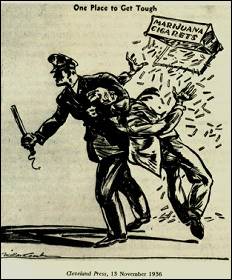
"One Place to Get Tough"
Cleveland Press, Nov 13, 1936
 NEXT PAGE